Last year, I decided it was time to pass my beloved George on to my daughter. Although I love him, I wasn’t really sewing with him much, and I wanted him to go to a home where he would get used more often. So I packed him up and sent him to live with Kerstin, because she was just beginning to sew and I thought she might enjoy the large throat and wonderful embroidery. Of course, that left me with a hole in my studio, and a need for a new back up machine. Enter the Pfaff Ambition 620.
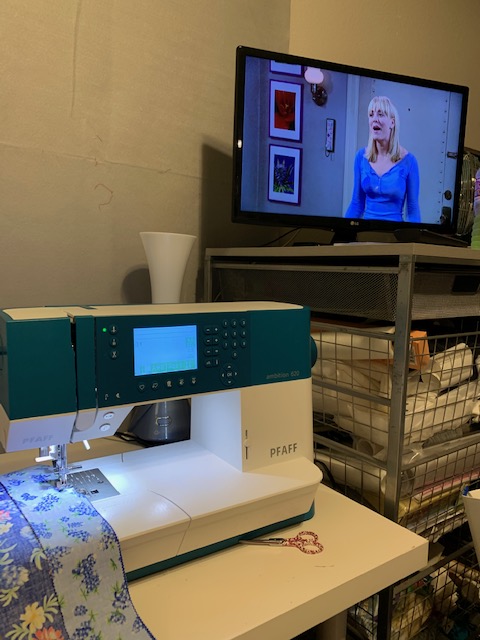
For full disclosure, I feel it necessary to let you know that I have traded this machine in on a Viking Sapphire 930. I’ll go over the reasons why I made that decision in this post, but I won’t review the Sapphire here.
I tried this machine out at McDougal’s Sewing Center in Katy, which is where most of my machines seem to come from these days. I already had a Pfaff Creative 4.5, so another Pfaff seemed like a no-brainer. While this machine has a reasonable price point (I paid $900), it still includes the IDT, which is the primary reason Pfaff machines are so celebrated. It also has adjustable speed control, nearly 8 inches to the right of the needle, and 136 stitches. It also offers great lighting and a thread cutter. In my humble opinion, it’s a good value.
My first project on this machine was to start a jelly roll quilt. I sewed strips together and then cut them apart. Sadly, I didn’t get much further than that on the project but I hope to return to it soon. I also used the machine to make a top, do some simple seam repairs, and make some masks. I didn’t do a lot of sewing on it, but I did enough to be able to say that it’s a solid machine, and it would be great as a class machine, or for a beginner, but I think for someone who has a nicer machine, or a more accomplished sewist, this machine may feel a little too “basic.”
The stitch quality on this machine is first rate. The tension is great, and I got beautiful stitches right out of the box. The IDT helps to keep those stitches even, and most of the time, I keep a 1/4″ foot with guide on my machine. I didn’t notice any wobbles or weirdness in the stitches at all, and I tried it out in several needle positions (using a utility foot, of course). It makes a beautiful three step zig zag, and the decorative stitches all looked great. I forgot to take photos, because you know … I never really expected to get rid of it so quickly, but I assure you that the stitch quality was just as good as my Creative 4.5.
The lighting is also very good. My house does not have good lighting, but the lighting on this machine really lit up the entire bed of the machine. It’s LED, so it’s a bright white and I had no issues seeing what I was working on, even when working with dark fabrics. The screen is black and white, and fairly small, but still big enough to convey the information you need. And the machine is fairly lightweight, so even someone like my mom could probably carry it back and forth to classes. It took me a while to fully understand how to change stitches, but after a little practice I worked it out.
The good thing about this machine is that it uses the same feet as the Pfaff Creative 4.5, even though the 4.5 is a 9 mm machine and the 620 is a 7 mm machine. But the bobbins for this machine are a standard Class 15, and the bobbins for the 4.5 are proprietary. That meant I had to buy bobbins, because I like to have several available. That was a little annoying, to be honest, but not really a deal breaker.
So why did I end up trading it in on a Viking Sapphire 930? Well, there are a few reasons, actually. For one thing, the button placement for the Start/Stop and Reverse is really bad. At my height and the way I sit, I couldn’t see the buttons, so more than once, I nearly ran my finger through by accidentally hitting Start/Stop instead of Reverse. Another thing I wasn’t crazy about was the need to physically raise and lower the presser foot. I have had the Pfaff Creative 4.5 for four years now, and I have become accustomed to the buttons to raise and lower the foot, or the tap of my foot on the foot pedal to do the same. And while the Ambition 620 does have needle down, what it doesn’t have is Pivot. I have come to rely on Pivot so much, it’s one of the primary reasons why I stopped using George shortly after I bought the 4.5. It is probably my most used, most enjoyed feature of my machine, and I realized just how much I use it when I had to use the 620 to make face masks. The 4.5 found itself in the shop in the middle of quarantine because the USB port had quit working, so I turned to the Ambition 620 to make some masks. I cannot tell you how frustrated I became when trying to add the nose wire to the mask without Pivot. Well, I suppose I can tell you, actually, because that’s when I packed up the Ambition 620 and took it back to the dealer and left with a Viking Sapphire 930. And I have zero regrets about doing it.
Who the Pfaff Ambition 620 is best suited for, in my opinion, is either an advanced beginner who’s looking for a machine that will grow with them, or someone looking for a class machine with few frills. The $900 price tag might be a deterrent to new sewists, but it shouldn’t be, because this is a good machine with a lot to offer, but not so much to overwhelm a newbie. It’s a great machine, even though I traded it in, and it has a lot of things you wouldn’t really expect from a machine under $1,000. Take a look at Berninas in that price range, for instance … oh wait, you can’t, because there aren’t any! You might be able to pick up a Bernina 325 for about $1,000, but it’s not a full size machine, where the Ambition 620 is. And the Ambition 620 offers that much sought after, always worthwhile IDT.
If you’re in the market for a machine that won’t break the bank and delivers more than the bare minimum, check out the Pfaff Ambition 620. It’s worth the time and effort when you’re ready to buy.
 Texas Quilt Girl
I’m trying to find price on this specific quilt to buy What is it??
I’m not sure to which quilt you are referring?