As my regular readers may know by now, I have been a sewing machine junkie for the last few years. Since I sold my Brother 2500D back in 2012, I have had a few machines.
Janome 8900

Brother DreamCreator VM5100

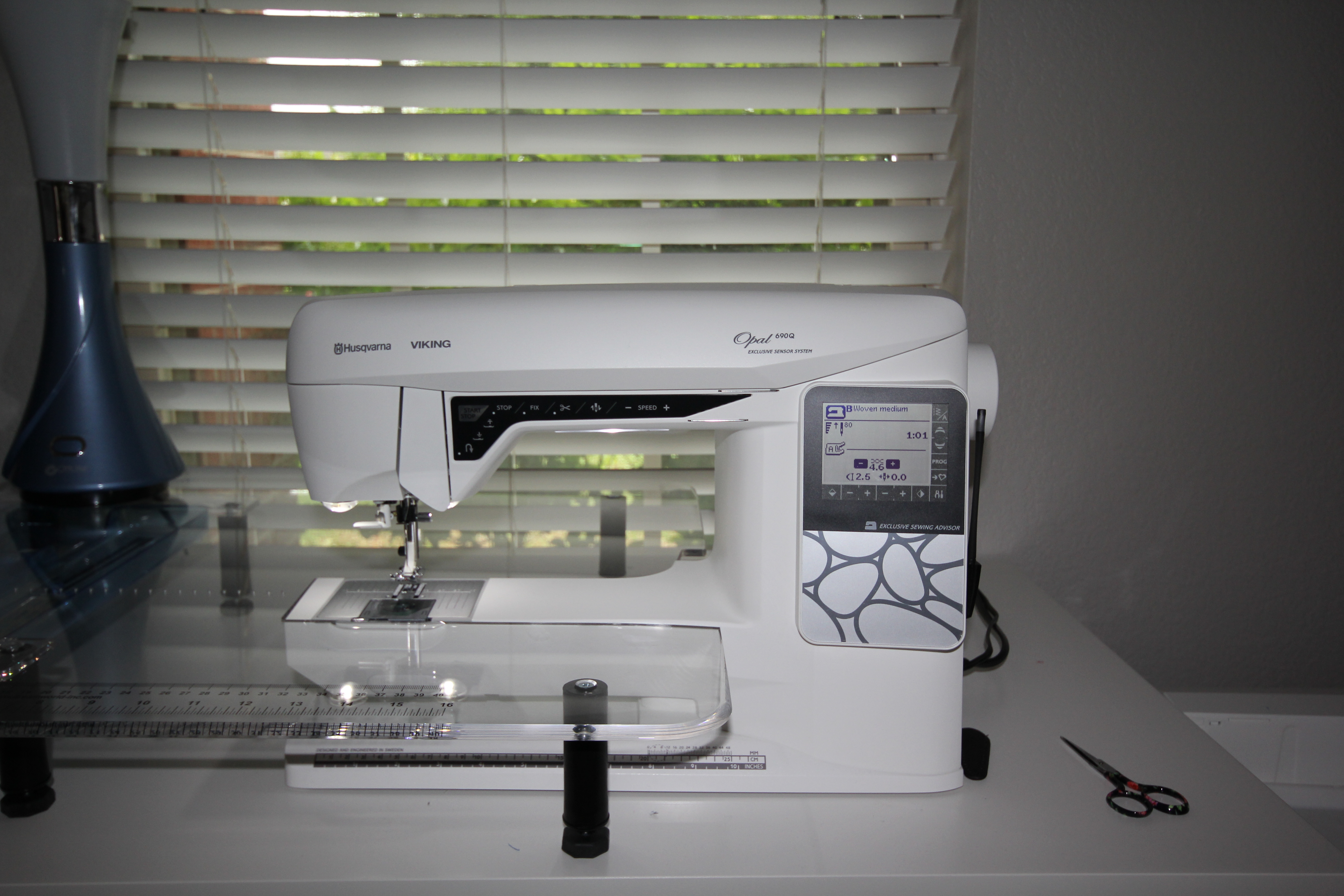
Viking Opal 690
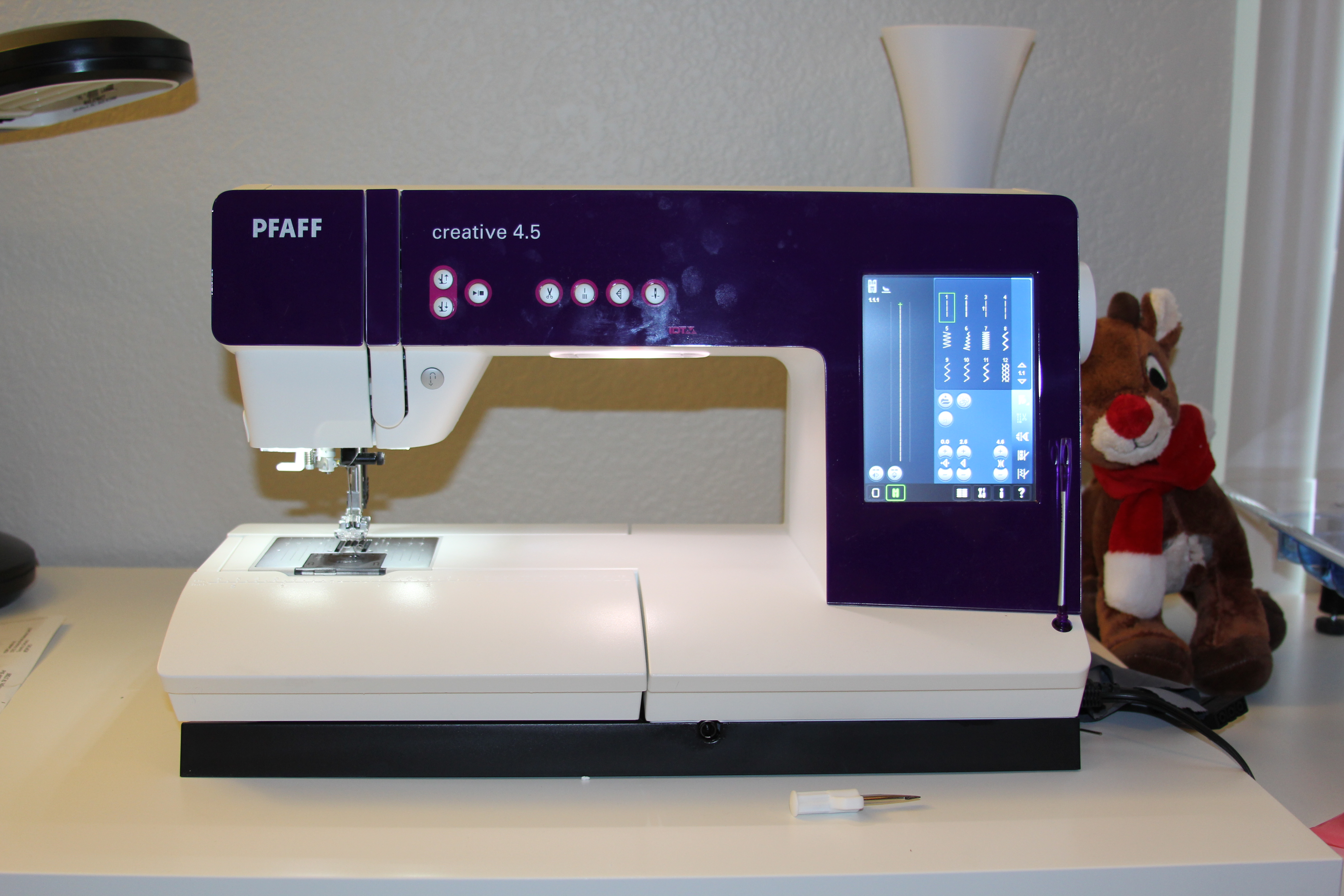
Pfaff Creative 4.5
Pfaff Ambition 620

Viking Sapphire 930

Bernina 435

Bernina 570QE

Most of these machines have come and gone. Of them, only the Brother and the two Berninas remain. I found the Bernina 435 on Facebook Marketplace, listed by someone who had purchased it during the pandemic, and whose foray into sewing was short-lived. I purchased it because I’d always wanted to try out a Bernina, and this seemed like a good way to do it at a reasonable price. And it is, in fact, a very nice machine.
What I like about the 435 is that it is a 5.5 mm machine, which means that the feed dogs are 5.5 mm wide, and that is the maximum size stitch it can produce. In today’s market, it is very uncommon to find a machine with such a narrow feed dog pattern, but it is very nice for precision sewists and quilters alike. The feed dog pattern is so narrow, in fact, as to render some of the best 1/4″ seams I’ve ever seen, and I’ve tried them all, as you can tell.
I also like the extra large bobbin, something no other sewing machine brand offers. Bernina claims that their bobbins hold 70% more thread, and I believe they are correct. It makes for a lot of piecing or quilting before the bobbin has to be changed. There’s nothing more frustrating than to be sewing happily along, and then realize that you’ve been sewing without a bobbin for the last 20 minutes. And yes, that does happen when a machine doesn’t have a bobbin sensor. It’s less common these days, because bobbin sensor is standard on a lot of even the lower end machines, but it can still happen, and I’ve been sewing long enough to have owned machines that had no such feature.
Before we move on from the bobbin, you should know, if you don’t already, that this is a front load bobbin, meaning that this machine has a bobbin more like machines from the 1950s. It doesn’t drop in from the top, but rather goes in to a bobbin case that you then put in the front of the machine. These types of bobbins have one distinct feature that I think is worth mentioning – they can produce perfectly straight stitches. Some of the top load bobbin machines will produce a straight stitch with a slight hook, or a little bit slanted, which I have been told is standard with that sort of bobbin hook. Bernina machines have front load bobbins, and thus are supposed to produce more of a straight stitch than their top loading counterparts.
One other thing that you should be aware of with the Bernina bobbin – you have to oil it every time you get ready to sew on the machine. This is different from other modern machines, which require no oiling by their owners, and are oiled instead on an annual basis during servicing. Its not difficult, nor is it a big deal – basically, three drops of oil each time you sew, and you’re golden. But for someone who is not accustomed to this sort of thing, it takes some getting used to doing it every time you turn the machine on.
The 435 has an adequate number of stitches – 650, according to the website. This is a sewing only machine, but it does the job it’s supposed to do very well. I have really enjoyed using this machine, despite it’s small size – just 7 inches to the right of the needle. It would be a great travel and/or class machine, because it’s fairly lightweight at about 21 lbs, and it has great lighting.
And I would be doing this machine a supreme injustice if I didn’t mention the feet. No snap on feet here – these are feet with the full ankle. They are sturdy and practical … and not even a little bit cheap. Granted, most of my machines have been Brother machines, whose feet ARE snap on, and I doubt anyone could call them pricey. The standard foot for my Brother machines usually runs less than $20. I thought the Viking and Pfaff feet were expensive – some of them were as high as $40 for a standard, nothing fancy about it foot. But Bernina feet could put a person in the poorhouse. A standard foot for this machine will set you back at least $50, usually closer to $75, and $100 isn’t unheard of. For this particular machine, though, I could get away with the 57 or 37 – both of which are 1/4″ feet – and be set, because I don’t think this would ever be more to me than a piecing machine.
I like this machine so much that I went and purchased a Bernina 570QE, which I do not like, for reasons I will not cover here. But after the challenges I’ve faced with the 570QE, and the realization that I like the ease of use of the Brother machines, I’m thinking about selling both Bernina machines and going exclusively Brother. If I’m being completely honest with myself and my readers, I don’t find the Bernina machines to be worthy of the hype surrounding them, nor the cost of the machines themselves, or the accessories. It’s a little bit like a Porsche or Ford … you’re buying the name, but not necessarily quality, and everything with the Porsche name attached to it is going to be more expensive than if you just buy a Ford. Both vehicles will get you to where you want to go, so I guess it’s a matter of whether or not you want to pay for the vehicle name, or if you’d rather pay for the features you want.
A couple of weeks ago, I bit the bullet and I invested in the Brother Stellaire XJ1. I’ve come full circle in my search for the “perfect” sewing machine, and I’ve decided that my hunt is over. If I do go through with the sale of my Bernina machines, I will use the proceeds to pay off the Stellaire, and then I may buy one more machine – another Brother, to be sure – for classes and travel. For now, I’m happy with the Brother machines I have. I’ve enjoyed trying out all of these machines, but in the end, you have to go where your heart leads you, and my heart led me back to my first love.
 Texas Quilt Girl
Thank you for your reviews! I love my vintage Bernina 1130 but it’s getting to be too heavy for me to lug around. I dog sit and take my machine everywhere. What I’d like to know is does your travel Brother have enough power to sew over heavy seams & can’t you tell me how much it weighs? Any info would be appreciated. I love the power of my Bernina & I don’t want to buy a machine that won’t sew over thick seams.
The writer of this comment emailed me and asked that I not approve the comment because she mis-read my post and thought I’d already purchased a Brother machine for travel/classes, but after some careful consideration, I decided to go ahead and post it. She and I had a little conversation in email, and this is the answer I sent her.
No worries; I understand completely.
I have my eye on a couple of machines and it depends greatly on if I decide to go with a sewing/embroidery combo machine, or just a sewing machine. I’m leaning toward the NS2750 with a 5”x7” hoop. I’m also looking at the NQ3700D. They are both 20-22 lbs.
If I go with sewing only, the Pacesetter PS500 is a contender. It’s about 20 lbs as well, and my dad used a similar machine to sew boat seat covers.
My suggestion would be to take some samples to your local dealer and try it out. Make sure the machine you consider has adjustable foot pressure. But most importantly, try it out on actual samples of what you sew. I think the Brother is the better choice but that’s my opinion. Make sure it does what you want it to do, and try not to settle, thinking you will be able to compensate for the machine’s shortfalls.
And please do not hesitate to reach out to me if you need any help with your search. I’d be honored to give my opinion and thoughts on any machine.
Best of luck in your search!
❤️ I’m a Texas girl too!